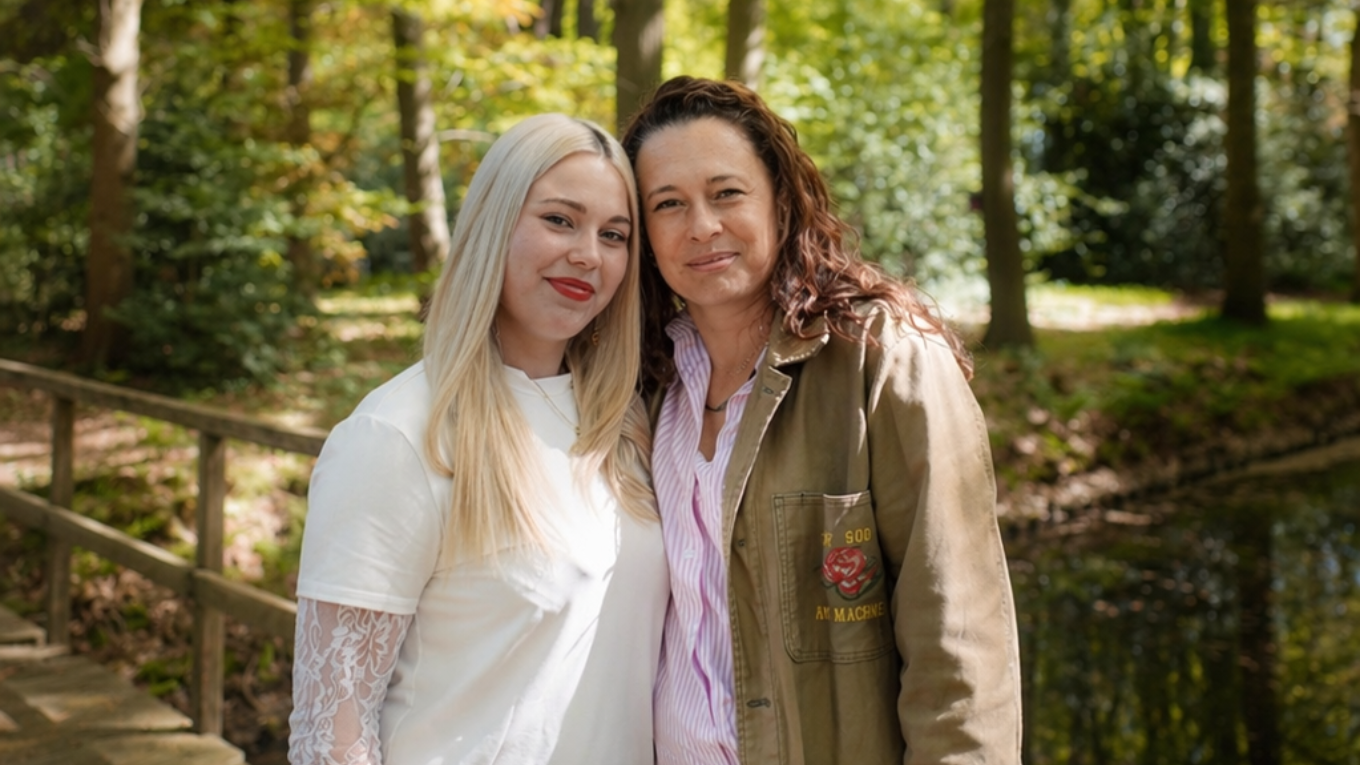
At the age of eleven, former fellow Isis started using substances. What followed was years of anger, frustration and growing distance — from herself and from her mother, Berny. As Isis spiralled deeper into addiction, her mother could do little but watch helplessly. Until Isis reached a point where she truly wanted to start living again.
For years, Isis’s life revolved around substance use. “If I hadn’t used, the day felt pointless to me.” Life felt like one constant battle. “I was frustrated and angry with the whole world.” Her substance use began at a young age. When she was eleven, her parents separated. Not long afterwards, she lost her grandmother. For Isis, that was the final straw, and she began experimenting with drugs to suppress her emotions. “Things went from bad to worse. First, I used every weekend, then every day of the week. At first with friends, then on my own. Eventually, I couldn’t even sleep or get out of bed without using.”
When Berny first saw her daughter under the influence, she was deeply shocked. “I confronted Isis, but she denied everything. I felt completely powerless. How was I supposed to stop this?” Isis did everything she could to keep her mother at a distance. “I didn’t want to hurt my mum, so I kept quiet. Our contact became less and less because I didn’t want to disappoint her. She had already been through so much in her life, and I didn’t want to burden her any further. It made me withdraw and keep everything to myself.”
“I didn’t want to hurt my mum, so I kept quiet. I didn’t want to disappoint her, which is why I kept myself at a distance.”
Former fellow Isis
Wanting a Normal Life Again
After years of substance use, the turning point came when Isis realised for herself that something had to change. “I didn’t want this anymore. I wanted to live, not just survive.” She had sought help before, but it never felt enough. “I would simply tell people what they wanted to hear. Then I’d go home and the first thing I’d do was use again. A one-hour session once a week wasn’t enough for me. There was so much more going on beneath the surface.”
When she eventually took the step towards Yes We Can, she found it terrifying. “I got on that bus and thought, ‘What have I done?’” At the start of treatment, she continued to put on a brave face. “Everything was fine, nothing was wrong with me, and I was just acting like the class clown. Then people started holding up a mirror to my behaviour, and it really made me think. I realised: I’m here pretending my life is perfect. But if my life had been perfect, I would never have ended up here.”
Real Connection
For Berny, the hardest part of treatment was having no contact with her daughter during the first five weeks. Halfway through the programme, however, something happened that neither mother nor daughter had experienced for a long time: genuine connection. “For the first time, we were able to have an equal conversation and talk about what had hurt us, without arguing. It was one of the most beautiful days of my life. That bond between us came back immediately,” Isis recalls.
“During Bonding Day, we were able to have an honest conversation as equals and share what had hurt us, without it turning into an argument.”
Former fellow Isis
A New Beginning
When Isis returned home, everything felt different. “For the first few weeks, I was on cloud nine. Everything was going well, and that was actually quite scary. You become so used to things eventually going wrong, but they just kept going well.” Slowly, she learned how to build a new life. “I can now enjoy the little things. Just playing a board game with family, for example. I used to hate that because my mind was always focused on using.”
She also discovered who she really was. “I always thought I was that angry girl, but now I know I’m someone I can be proud of.” Of course, life is not always easy. “When things feel unfair, that anger still comes up.” The difference lies in how she responds to it. “Now I can make mistakes and learn from them.”
After her time at Yes We Can, Isis also realised that some friendships from her old life no longer fitted with her recovery. “After treatment, I asked my friends not to use substances or be under the influence when I was around. In the end, they often stopped showing up altogether. At first, I found that really difficult because I thought: aren’t they my friends? Especially in the beginning, I felt very lonely.” But over time, her perspective changed. “I started thinking about how I would have reacted when I was still using. Back then, I was very self-centred too, so I probably would have done exactly the same.”
A Different Mother–Daughter Relationship
A great deal changed for Berny as well. Through the parent programme, she became more aware of her own role as a mother. “In many ways, I had been reinforcing her behaviour. That’s quite confronting to realise.” Where there was once distance, there is now connection. “We message each other, FaceTime, and share things about our lives.” Berny clearly sees the difference. “I can now talk to Isis about her behaviour, and she actually understands where I’m coming from. Before, that simply wasn’t possible without her becoming angry or shouting.”
Today, Isis is rebuilding her life. She is completing an internship, has a job and is looking towards the future. “I want to make a difference for young people who are struggling, just as I did.” When she reflects on her journey, she sees how far she has come. “Before, I was only surviving. Now, I’m truly living.”
Discover what Yes We Can Youth Clinics can do for you
Would you like to learn more about Yes We Can Youth Clinics and the way we work? Feel free to get in touch with us with no obligation, and we’ll be happy to tell you more.
Contact us